Renaissance Music (1400–1600) — Theory and Playable Examples
This is the second stop in my walk through classical music one era at a time. The first one covered medieval music, up to 1400. This one is the Renaissance, roughly 1400 to 1600.
To place it loosely in time: it starts around Jan Hus being burned at the Council of Constance and ends around Giordano Bruno being burned in Rome. The period gets presented as humanism and the discovery of man. The same 200 years also hold the Reformation, the Counter-Reformation, the Inquisition, the wars of religion, and the witch hunts. The music was written in the middle of all that.
I’m learning piano, so this is a study log as much as anything. The examples are sheet music you can play in the page.
The one change that matters most is the third
The medieval rule was this:
Perfect unison / 5th / 8ve = sacred. The 3rd = imperfect.
The Renaissance rule is this:
Thirds and sixths are also primary consonances.
Here are two D chords. The first has no third in it. It sounds gapless and hollow, and that hollow sound has a name: an open fifth or open octave. The second one adds a single F, and the chord turns round and thick.
Before you press play: this was vocal music. What comes out here is a plain synth. Each example has a play button under the staff.
People say medieval music is dry and Renaissance music is sweet. Most of that difference comes down to whether that F is there or not.
Why it turned sweet, and what came after
The sound came from England
The credit goes to the English school. John Dunstaple (Dunstaple, d. 1453) wrote with thirds and sixths at the centre of the sound.
The Burgundian poet Martin le Franc gave it a name in his poem Le Champion des Dames, 1441–42: contenance angloise, the English manner. He wrote that Du Fay and Binchois had taken up that sound.
Whether Dunstaple himself spent time in France isn’t documented clearly. What is certain is that copies of his works survive in Italy and elsewhere, so at minimum the scores travelled.
The habit of adding one semitone
Musica ficta is a forbidding name for a simple action: raise the note just before the ending by a semitone.
Raised, it sits immediately next to the final, and the sense of “this has ended” gets much stronger. That raised note is the leading tone.
Here is the same phrase twice — first G→A, a whole tone, which sounds archaic and unfinished, then G♯→A, a semitone, which ends decisively.
In the Middle Ages this was an exception reserved for cadences. In the Renaissance it’s everywhere.
Adding semitones gradually pulls the modes toward major and minor. The 200 years of the Renaissance are that transition.
At the end it splits in two
Palestrina pushed order to its limit. Gesualdo used chromaticism to destroy the tonal centre. Both are late Renaissance, and they point in opposite directions.
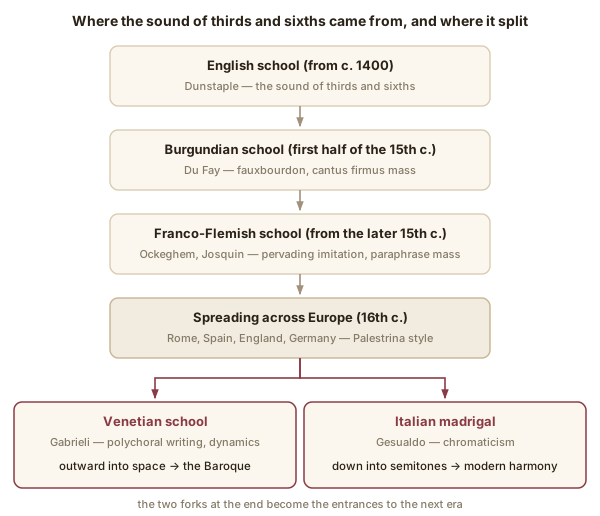
The whole 200 years. The two forks at the bottom are where the Renaissance ends.
What this covers
Eight sections, then a glossary.
- Sound — thirds and sixths take the lead, and the modes drift toward major and minor
- Writing — imitation, and the three stages of mass technique
- Cadences — musica ficta and the catalogue of closes
- The norm: Palestrina style — five rules, each with a bad example and a good one
- Secular music — national forms, the text taking charge, and homophony against polyphony
- Space and deviation — Venetian polychoral writing and Gesualdo’s chromaticism
- What the performer decides — diminution, tuning, and regional sound
- Glossary — the terms in one place
Sound
First, changes in the sound itself: thirds and sixths take the lead, and the modes drift toward major and minor.
① Thirds and sixths become consonant
What changed is how chords get stacked.
Four chords in C. The one to listen for is the second. The chord sounding is F major — F, A, C — but the lowest note is A, not F. Counting up from that A, C is a third above and F is a sixth above. A chord made of nothing but a third and a sixth.
Medieval writing passed through this shape on the way to somewhere else. Renaissance writing can rest on it. Using it over and over as a way-station is what the “sweet English sound” actually is in practice.
There’s a counterpart to that promotion. As the third moved up, the perfect fourth moved down.
| Interval | Middle Ages | Renaissance |
|---|---|---|
| thirds and sixths | imperfect consonance, only passed through | become primary consonances |
| perfect fourth | perfect consonance, ranked just after unison and octave | dissonant only against the lowest voice; still consonant between upper voices |
Medieval parallel organum stacked exactly those perfect fourths and fifths. In 13th-century theory the fourth and fifth ranked above thirds and sixths, just below unison and octave.
That changes in the 15th century. Johannes Tinctoris, in Terminorum musicae diffinitorium (1473), is the first theorist to classify the fourth as a dissonance.
It isn’t a blanket demotion. The fourth is dissonant only against the lowest voice. Between upper voices it stays consonant — which is exactly what fauxbourdon depends on.
② Fauxbourdon
Fauxbourdon is a way of mass-producing the sweet sound of ①. It’s a staple of the Burgundian and English schools.
The method: the middle voice simply traces a perfect fourth below the top voice, and the lowest voice sits a sixth below the top. Do that and the third-plus-sixth chords line up automatically.
The last chord drops the third and opens out to a hollow fifth plus octave. That’s a leftover of the medieval cadence.
In the original manuscripts the middle voice isn’t written out. Only the top and bottom voices were notated, with an instruction to sing a fourth below the top. Here it’s spelled out so you can hear it.
The earliest datable example is Du Fay’s motet Supremum est mortalibus, from around 1433.
③ Toward twelve modes
Two modes get added to the medieval eight in the middle of the Renaissance. Glareanus, in Dodecachordon (1547), admits Ionian (C–C) and Aeolian (A–A). The prototypes of major and minor are now recognised in theory as well.
| Mode | Finalis (final note) | Tenor (axis note) | Character |
|---|---|---|---|
| Aeolian (IX) | A | E | natural minor scale; ancestor of the minor |
| Ionian (XI) | C | G | major scale; ancestor of the major |
Theory didn’t come first here. With musica ficta adding semitones everywhere, Europe was already hearing something close to major and minor. Glareanus put a name on what was already happening.
3-1. Aeolian (A-Aeolian)
Ends on A, sings around E. Raise the G to G♯ just before the end — musica ficta again — and what you get is essentially a modern minor ending.
3-2. Ionian (C-Ionian)
Ends on C, sings around G. Nothing needs adding here: the B→C at the close is already a semitone. The major-ness is built in.
3-3. What happened to the four medieval modes
Dorian, Phrygian, Lydian and Mixolydian stay in use, but they drift toward major and minor as the semitone habit spreads.
| Mode | Semitone added | Where it ends up |
|---|---|---|
| D-Dorian | C♯ (leading tone) | a minor close to A minor |
| F-Lydian | B♭ (avoiding the tritone) | practically F major |
| G-Mixolydian | F♯ (leading tone) | practically G major |
| E-Phrygian | (often left alone) | keeps its modal character to the end |
By the end of the Renaissance the modal system has effectively collapsed into major and minor. Phrygian is the exception. It survives as a kind of church darkness, and Gesualdo later amplifies that darkness with chromaticism.
Writing
Next, how the voices get stacked. In the Middle Ages each voice had a fixed role. In the Renaissance everyone passes the same melody around.
④ Pervading imitation
A short melodic fragment — the motif — is passed from voice to voice with a time lag. This is the core of the Franco-Flemish school, Ockeghem and Josquin.
It’s close to a round, but not the same thing. Unlike a round, the later voices can enter at a different pitch level and break away freely partway through.
Here it’s reduced to two voices. The lower voice states the motif and the upper voice follows one bar later.
In real four-voice writing this happens four times over, Bass→Tenor→Alto→Soprano or the reverse. The standard imitation intervals are the octave, the perfect fifth and the perfect fourth.
In the Middle Ages the lowest voice held the chant and the upper voices decorated it — that’s free organum. Everyone singing the same melody is a large shift away from that.
| Variant | What it does |
|---|---|
| augmentation | the following voice imitates at double note values |
| diminution | the following voice imitates at half note values |
| inversion | the motif is turned upside down (up becomes down) |
| retrograde | the motif is read backwards |
All of these extend late-medieval canon, Machaut’s Ma fin est mon commencement and the like.
⑤ Cantus firmus mass
An existing melody is set as the foundation and the whole mass is built on top of it. That foundation is the cantus firmus.
In 15th-century Burgundian masses it sits in the tenor at hugely stretched note values — one note lasting four times as long — so you can barely hear it as a melody at all. The other voices move freely above it.
The decisive novelty is that the foundation could be a secular song. Du Fay’s Missa Se la face ay pale puts the melody of his own secular chanson straight into the tenor of a mass.
Having a popular tune sung as the music of God was also a way of pulling the secular world inside the church.
⑥ Paraphrase mass and parody mass
From ⑤, the way the foundation gets used opens up in two further stages.
| Stage | How the foundation is used | Example |
|---|---|---|
| cantus firmus mass | held in the tenor alone, at long note values | Du Fay, Se la face ay pale |
| paraphrase mass | distributed across all voices, decorated | Josquin, Pange lingua |
| parody mass | an existing polyphonic piece reworked whole | Palestrina’s later masses |
In a paraphrase mass the foundation is no longer the tenor’s property. Fragments of the same melody surface in every voice.
A parody mass goes further. The foundation isn’t one melody but a whole polyphonic piece — the combination of voices quoted as a block from an existing motet or chanson.
Here’s the source: a two-voice combination as it might appear in a motet.
And here are the same two voices kept intact, with a new lower voice added underneath.
The upper two voices are identical in both. Adding the bass fixes the chord quality and changes how the whole thing sounds. A real mass then drifts away from the quotation and develops freely from there.
It worked as a mark of respect to the original composer and as an efficient reuse of material at the same time. It’s a technique that let church music be produced in quantity.
One note: using secular songs as the foundation did draw criticism in the 16th-century church reform debates. No rule forbidding it was ever made by the council, though — see ⑨.
Cadences
Now, how a phrase closes. In the Middle Ages the cadence was a rule about how voices move. In the Renaissance a vocabulary of closes as chord successions grows on top of that.
⑦ musica ficta
Manuscripts of the time barely wrote accidentals. They didn’t need to — performers filled them in by convention. That unwritten raising and lowering of semitones is musica ficta.
The most common use is making a leading tone just before the close. It’s the same action in every mode.
The other use is avoiding the tritone. F followed by B gives the unstable interval that had been disliked since the Middle Ages — the tritone, an augmented fourth — so B is lowered to B♭ and it becomes a perfect fourth.
In madrigals, whether the B stayed natural or went flat was switched word by word. Hard words got B natural, soft words got B♭. Choosing notes by what the text means is the road into text painting (⑪).
⑧ A catalogue of cadences
Essentially every cadence still in use today gets assembled during this period. It carries on the medieval clausula vera and double leading-tone cadence and adds new shapes on top.
One caveat before the examples. The Roman numerals under them — V–I and so on — are an analytic notation invented later. Musicians of the time did not think in those symbols. They’re here only because they make the position easy to grasp.
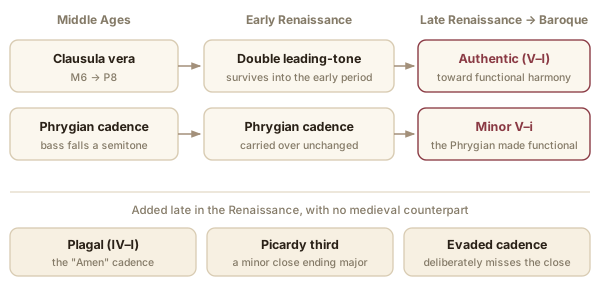
Where the medieval cadences flowed to.
8-1. Authentic cadence (V–I)
The most familiar close there is. The bass falls a fifth, or rises a fourth, onto the final. It’s the same sol→do motion used in pop music today.
8-2. Plagal cadence (IV–I)
The “Amen” at the end of a hymn. The bass rises a fourth, or falls a fifth. A softer landing than V–I.
8-3. Phrygian cadence
Carried over from the Middle Ages. The bass falls a semitone while the upper voice rises a whole tone, so the two close in from both sides. By the late Renaissance it’s standardised as a resting point midway through a piece in the minor.
8-4. Picardy third
A dark piece whose final chord alone turns bright. A piece moving in A minor ends on A–C♯–E, which is A major. It appears in the Renaissance and stays in use right through the Baroque.
The name came much later. Rousseau’s music dictionary (1768) is the first known use of it. The practice ran about 200 years ahead of the name.
8-5. Evaded cadence
It looks like it’s going to close, then deliberately misses. The bass doesn’t go to the final; it veers somewhere else.
It should return to C, and it veers to A instead. Madrigals and motets use this to keep the listener aware that the text is still going.
The norm: Palestrina style
⑨ Five rules
Worth getting the facts straight first. What the Council of Trent (1545–63) actually put in its decrees about music is one clause, from Session 22 (1562):
Banish from the churches all music that contains, whether in the singing or in the organ playing, things that are lascivious or impure.
Intelligibility of the text and the use of secular melodies were discussed at the council, but neither made it into the decrees. The famous story — that the council nearly banned polyphony, and that Palestrina’s Missa Papae Marcelli made them back down — spread in the 19th century through Baini’s 1828 biography and has no support. The mass was composed around 1562 and published in 1567.
Palestrina’s music was nonetheless received as the model for church music, and later counterpoint teaching, Fux’s Gradus ad Parnassum (1725) above all, reorganised the style into teaching material.
Second caveat, and it matters: the five rules below are the shape Fux gave it 200 years later. Palestrina had no such rulebook. It was extracted from his music by later generations, and actual pieces depart from it in places.
| Rule | What it says |
|---|---|
| reverse direction after a leap | after a big leap, come back stepwise in the opposite direction |
| prepare and resolve dissonance | sound the clashing note in the previous chord, then let it fall a step |
| no parallel fifths or octaves | the same perfect interval must not continue |
| avoid the tritone | avoid F–B (adjust with musica ficta) |
| keep voices independent | do not move in the same direction onto the same note; keep voice crossing rare |
9-1. After a leap, come back the other way
The bad version. C G c e — it leaps a fifth and then keeps climbing. Hard to sing, and the line flies upward and never comes back.
The good version. C G F E — the leap gets filled in stepwise in the opposite direction.
9-2. Sound the clashing note in advance, then let it fall a step
Two words that need pinning down. Dissonance here means an interval that sounds muddy when two voices sound together — seconds and sevenths are the typical cases. It’s about the interval between voices, not about chord names like IV or V. Resolution means moving the muddy voice a step to a clean interval. It isn’t a chord progression like V→I.
Being muddy isn’t forbidden. What’s forbidden is leaping into the muddy note.
The bad version: the upper voice leaps from G down to D, making a seventh against the bass E. It arrives with no warning.
The good version is identical except for the first bar. The D is sounded a bar earlier, where it’s a fifth against G and still clean, tied over, and then only the bass moves.
| Stage | What happens | In the example |
|---|---|---|
| preparation | the note that will clash is sounded before it clashes | bar 1; D against G is a fifth, still clean |
| dissonance | the upper voice stays put, only the lower voice moves | first half of bar 2; the bass becomes E, a seventh against D |
| resolution | the clashing note falls a step | second half of bar 2; D falls to C, a sixth |
The upper voice never moves. The clash is created and undone by what happens around it, which is why the dissonance never appears abruptly.
This shape is called a suspension. Because the prepared note is held over into the next bar, holding a note is part of the deal. In Palestrina style a dissonance on a strong beat is basically only ever this shape. A short clash while passing between neighbouring notes — a passing tone — is allowed off the beat.
The same treatment applies to the fourth against the lowest voice, which is where ① comes back in.
9-3. Do not let perfect fifths or octaves continue
Two voices holding a fifth or an octave while moving in parallel melt into one voice. Move one of them the other way, onto a different interval.
The bad version: fifth to fifth.
The good version: fifth to third, by contrary motion.
The same thing happens with octaves.
9-4. Avoid the tritone
F and B don’t settle, whether sounded together or in succession — see ⑦. Lower the B to B♭.
The bad version, an augmented fourth:
The good version, a perfect fourth:
One note lowered by a semitone and the unsettled quality is gone.
9-5. Do not land on a perfect interval moving in the same direction
If both voices move the same way onto a unison, an octave or a fifth, the two lines fuse for that instant. Move one of them the other way onto the landing.
The bad version: both rise, sixth to octave.
The good version: contrary motion, fifth to octave.
What all five rules share is that the voices never melt together. Each one stays audible as an independent line. The reputation Palestrina has for intelligible text comes from the same place.
Secular music
Outside the church something else entirely is going on. The text takes charge.
⑩ National forms
Late-medieval secular songs had strictly fixed poetic shapes — ballade, rondeau, virelai, the formes fixes. Renaissance secular music moves on to free shapes.
| Form | Language | Character | Example |
|---|---|---|---|
| chanson | French | through-composed, 4 voices, homophonic leaning | Josquin, Mille Regretz |
| madrigal | Italian | through-composed, 5 voices, text painting | Gesualdo, Moro lasso |
| Lied | German | tenor carries the cantus firmus, folk material | Isaac, Innsbruck |
| villanella | Italian | strophic, 4 voices, light | Lassus, Matona mia cara |
| frottola | Italian | strophic, 4 voices, simple and chordal | Tromboncino |
| canzona | Italian | free, instrumentalised, leading to later instrumental music | G. Gabrieli |
Through-composed and strophic are a pair of opposites. Strophic reuses the same music with new words, the way hymns work. Through-composed does the reverse: new music for every line.
The madrigal is through-composed. New words mean new music, so the content of the text outranks the form.
⑪ Text painting
The meaning of the words gets drawn in the shape of the notes. “Rising” makes the melody rise. “Death” stops the sound. It was codified in 16th-century Italian madrigals and later carried into the English madrigal school.
| Word or idea | Figure |
|---|---|
| ascension, rising, hope | ascending figures and leaps |
| descent, lament, death | descending figures, descending semitones |
| pain, grief | chromaticism, dissonance |
| death, ending | full rest (the sound stops) |
| unity, harmony | homophony (everyone in the same rhythm) |
| scattering | dispersal into polyphony |
| speed | small note values |
| eternity, stillness | long note values, pedal tones |
| birdsong | trill-like decoration |
| chains, bondage | continuous syncopation |
Palestrina’s Sicut cervus sets Psalm 42, “as the deer pants for water”. The panting is drawn with an ascending figure.
Lassus’s Holy Week motet Tristis est anima mea does the opposite. “My soul is sorrowful” is drawn with descending motion and semitones.
Same technique, wildly different dosage. Palestrina keeps to a calm octave rise. Gesualdo pushes chromaticism until it collapses (⑭).
⑫ Homophony against polyphony
Homophony moves every voice in the same rhythm. Polyphony lets each voice run on its own. Both existed long before the Renaissance. What is new here is going back and forth between the two inside one piece.
The reason is the words. If the voices sing different syllables at different moments, the text does not come through. If they all move together, it does. As ⑪ showed, 16th-century secular music was already bending toward the meaning of the text, and in church music the intelligibility of the words came up in the reform debates too (it never made it into the decrees — see ⑨).
So the change of texture becomes the expressive move. Converge on homophony where the words matter, then scatter back into polyphony on the next line. What shifts the listener’s attention is not volume but how densely the voices are moving.
The first two bars move all three voices in one rhythm, which puts the text out front. From bar 3 the upper voice goes on ahead, the lower ones enter in turn, and the weave comes back.
Run the same contrast between choirs seated apart from each other, and you get ⑬.
Space and deviation
The late Renaissance splits two ways: outward into space, and downward into semitones.
⑬ Venetian polychoral writing
Cori spezzati splits the choir in two and has the halves answer each other from separated positions. It spread through northern Italian churches during the 16th century.
It suited St Mark’s in Venice especially well, because the two organ lofts are set apart and the choirs could be placed separately. Willaert, maestro di cappella there in the 1540s, is an early practitioner. Andrea and Giovanni Gabrieli later made it widely known.
The basic shape comes in three parts: one side sings, the other answers, then both together.
Gabrieli’s Sonata pian’e forte (1597) is also one of the earliest examples of dynamics written into the score. A single piano can’t reproduce the spatial spread, but swapping in a contrast of high and low register along with f and p gets you something of the effect.
⑭ Gesualdo’s chromaticism
The other road. Carlo Gesualdo and Nicola Vicentino tried extreme chromaticism, sliding chords by semitones until you can’t tell where the centre is.
Here the bass climbs C–C♯–D–D♯–E–F by semitones. Each chord on its own is an ordinary triad. Strung together, the floor keeps moving and there’s nowhere to return to.
Vicentino went further and built the archicembalo, a keyboard with 31 keys to the octave. It was also an attempt to reconstruct the ancient Greek genera.
The other device is cutting the relationship between chords. Here the bass stays on A while the C♯ above it falls to C. A bright chord and a dark chord placed side by side, and the character is swapped out from under you. The preparation-and-resolution rule from ⑨ isn’t observed at all.
Gesualdo’s Moro, lasso, al mio duolo (1611) sets a text that means roughly: “I die in my suffering / and she who could give me life / alas, kills me / and will never give me relief.” That text becomes the chromatic collapse itself.
As a matter of documented record: Gesualdo murdered his wife and her lover in 1590. A composer whose deviation from the norm reached its limit in his life as well as in his music.
What the performer decides
A large part of Renaissance music isn’t written down. Without knowing that, playing the notes as printed stops at tidy counterpoint.
⑮ Diminution
Long notes get broken up and decorated by the performer on the spot. The feel is close to jazz improvisation. Ortiz, Trattado de glosas (1553) and Ganassi, Fontegara (1535) wrote down the pattern books.
What the score says:
What actually gets played:
The skeleton doesn’t change. Bar 1 is C, bar 2 is E. The space between them is filled with neighbouring notes.
Joining long notes with figuration like this is called passaggi, and it was used heavily in English consort music and Spanish vihuela music. Medieval decoration was limited to wobbles around the cadence. Renaissance decoration is a system that can be spread across a whole phrase.
⑯ Performance practice and regional difference
| Element | How it actually was |
|---|---|
| musica ficta | the performer decides the semitone on the spot (before cadences, avoiding tritones) |
| diminution | the performer breaks up the written note values |
| tuning | not today’s equal temperament but meantone; thirds ring clean, distant keys go badly out |
| forces | a cappella is the baseline, but instruments often reinforced or replaced voices |
| vibrato | non-vibrato singing is the scholarly mainstream |
| School | Centre | Character of the sound |
|---|---|---|
| England | London, Eton | sweet thirds and sixths, boy trebles |
| Burgundy | Dijon | top-voice led, chanson elegance, fauxbourdon |
| Franco-Flemish | Bruges, Cambrai | strict pervading imitation, voices as equals |
| Rome | St Peter’s | Palestrina style, male-voice a cappella |
| Venice | St Mark’s | polychoral writing, dynamics, instruments joining in |
| Spain | Toledo, El Escorial | mystical, dark harmony (Victoria) |
| Germany | Nuremberg, Prague | tenor Lied, folk material |
For playing this on a piano, the settings shift a little from the medieval post. Lean toward non-legato. Use the pedal only to join a phrase. Sound every voice at the same strength, without letting a melody stick out. Keep the dynamics inside pp–mp, apart from Gabrieli’s f/p contrast.
Summary — five things that define the Renaissance
| Element | How the Renaissance treats it | Resulting sound |
|---|---|---|
| thirds and sixths | used as primary consonances, not only perfect intervals | the sweet English sound |
| imitation | one motif presented by every voice in turn (pervading imitation) | Franco-Flemish density |
| musica ficta | leading tones before cadences, tritone avoidance, the Picardy third | approach to major and minor |
| text painting | the meaning of words drawn in figures (rising = ascension, falling semitone = grief) | words and notes in sync |
| norm and deviation | Palestrina’s order and Gesualdo’s chromaticism side by side in one era | the range of the late Renaissance |
Glossary
Writing techniques
| Term | Original | Meaning |
|---|---|---|
| fauxbourdon | fauxbourdon (Fr., “false bass”) | the middle voice runs a perfect fourth below the top voice and the lowest a sixth below, so chords of a third plus a sixth line up automatically. The middle voice was not notated. |
| faburden | faburden (Eng.) | the English practice. The chant sits in the middle voice, with parts added above and below — unlike fauxbourdon, where the cantus firmus is on top. |
| pervading imitation | — | a short motif passed through all the voices in turn with a time lag. |
| cantus firmus | cantus firmus (Lat., “fixed song”) | an existing melody set as the foundation of a piece. |
| cantus firmus mass | — | a mass in which the foundation is held in the tenor alone, at long note values. |
| paraphrase mass | — | a mass in which the foundation is distributed across all the voices and decorated. |
| parody mass | — | a mass built on an existing polyphonic piece, quoted as a block of voices. |
| Palestrina style | prima pratica (It., “first practice”) | the norm of church counterpoint extracted from Palestrina by later generations. |
| musica ficta | musica ficta (Lat., “feigned music”) | semitone raising and lowering that the sources don’t write and the performer supplies. |
| leading tone | — | the note a semitone below the final; raised by musica ficta to strengthen the close. |
| text painting | — | drawing the meaning of the words in the shape of the notes. |
| cori spezzati | cori spezzati (It., “separated choirs”) | splitting the choir and placing the halves apart so they answer each other. |
| diminution | — | breaking a long note into shorter ones as decoration, decided by the performer. |
| passaggi | passaggi (It., “passages”) | figuration that joins long notes across a phrase. |
| homophony | — | all voices moving in the same rhythm. |
| polyphony | — | several independent voices moving at once. |
| through-composed | durchkomponiert (Ger.) | new music for every line of text, as opposed to strophic. |
| motif | — | the short melodic fragment that imitation passes around. |
| suspension | — | preparation, dissonance and resolution in one shape: hold a prepared note while the other voice moves, then step down. |
| preparation | — | sounding the note that will clash before it clashes, in a consonant interval. |
| resolution | — | moving the clashing voice a step to a clean interval. |
| passing tone | — | a short clash created while passing between neighbouring notes, allowed off the beat. |
Intervals
| Term | Original | Meaning |
|---|---|---|
| consonance / dissonance | — | consonance is an interval that sounds clean when two voices sound together; dissonance is one that sounds muddy — seconds and sevenths being typical. |
| open fifth, open octave | — | a chord with no third in it; the hollow medieval sonority. |
| tritone | tritonus (Lat.) | the augmented fourth, F–B; unstable, and avoided by lowering B to B♭. |
| perfect fourth | — | a perfect consonance in the Middle Ages. In the Renaissance it’s dissonant only against the lowest voice, and stays consonant between upper voices. |
Cadences
| Term | Original | Meaning |
|---|---|---|
| Authentic cadence | — | V–I; the bass falls a fifth or rises a fourth onto the final. |
| Plagal cadence | — | IV–I; the “Amen” close, a softer landing than V–I. |
| Phrygian cadence | — | the bass falls a semitone while the upper voice rises a whole tone; carried over from the Middle Ages. |
| Picardy third | tierce de Picardie (Fr.) | a piece in the minor whose final chord alone is major. Named for the first time in Rousseau’s dictionary of 1768. |
| evaded cadence | — | a close that is set up and then deliberately missed; the bass veers away from the final. |
| double leading-tone cadence | — | the 14th-century three-voice cadence with two raised notes, surviving into the early Renaissance. |
Modes and genres
| Term | Original | Meaning |
|---|---|---|
| Ionian (XI) | — | finalis C, tenor G; the major scale, ancestor of the major. |
| Aeolian (IX) | — | finalis A, tenor E; the natural minor scale, ancestor of the minor. |
| Glareanus | Heinrich Glarean (1488–1563) | Swiss theorist; proposed the twelve modes in Dodecachordon (1547). |
| meantone temperament | — | the Renaissance tuning; thirds ring clean, and distant keys go badly out. |
| madrigal | madrigale (It.) | Italian secular form; through-composed, usually five voices, driven by text painting. |
| chanson | chanson (Fr.) | French secular form; through-composed, four voices, leaning homophonic. |
| Lied | Lied (Ger.) | German secular form; the tenor carries the cantus firmus, often folk material. |
| villanella | villanella (It.) | light Italian strophic form for four voices. |
| motet | motetus (Lat.) | a polyphonic sacred setting; along with the mass, the main sacred genre. |
References
- Contenance angloise (Wikipedia) — Martin le Franc’s name for the English sound
- John Dunstaple (Wikipedia) — the English school and the sound of thirds and sixths
- Fauxbourdon (Wikipedia) — fauxbourdon and how it differs from faburden
- Dodecachordon (Wikipedia) — Glareanus and the twelve modes
- Musica ficta (Wikipedia) — the unwritten semitones the performer supplies
- Council of Trent, Session XXII decree text (Wikisource) — the one clause the council actually issued about music
- Pope Marcellus Mass (Wikipedia) — the mass, and the “saved polyphony” legend
- Venetian polychoral style (Wikipedia) — cori spezzati and St Mark’s
- Carlo Gesualdo (Wikipedia) — the chromaticism, and the life
- Nicola Vicentino (Wikipedia) — the archicembalo and its 31 keys to the octave
- Meantone temperament (Wikipedia) — the tuning behind the clean thirds
- Trattado de Glosas (IMSLP) — Ortiz’s 1553 pattern book for diminution