Where human words go in the age of AI
Where do human words go from here? Lately I’ve been turning that over in my head.
People put out “thought + expression”
People take what they feel, what they think, what they reason out, and put it into the world in all sorts of forms:
- as words
- as drawings
- as songs
- as writing
- as dance
There are always two layers here: what you thought (thought) and how you gave it form (expression). This whole piece runs on that “thought + expression” split.
Putting out expression got easier and easier
Online expression grew richer too — from text to images, audio, and video; bulletin boards and social media made it two-way, and eventually you could even livestream.
Back when we still called them “homepages,” you’d rent a server or stand one up yourself, write HTML, upload it, and update it by hand. Just getting your thoughts online carried real cost1.
| Era | How you published | Cost |
|---|---|---|
| The homepage days | Set up a server, write HTML, upload it | High (skill and effort) |
| Since social media | Make an account and just post | Low |
Once social media turned it into “just post,” even people who’d felt “a homepage is a bit much” started moving, and both writers and readers grew in number.
Platforms have gathered expression and turned it into money
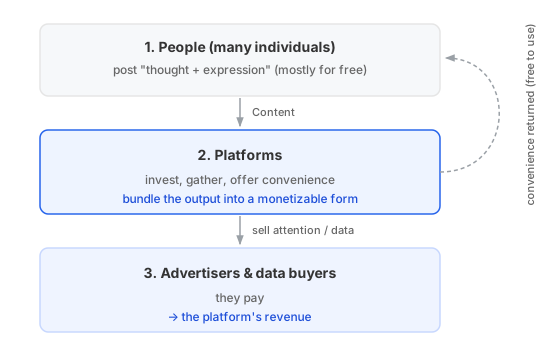
Platforms invested in their systems, offered convenience to users, and gathered up the output of “thought + expression” to turn it into money.
This setup already has names. Collecting behavioral data to predict and sell future behavior is called “surveillance capitalism”2; an economy that turns people’s attention itself into advertising money is the “attention economy”3. Whatever you call it, what sits at the base is the output people produced.
Now AI has started to take over “expression”
Lately, with the rise of AI, the things you can make on a computer — text, images, audio, video — are being substituted one after another. A single model now writes video from a sentence, or turns audio into text4.
In “thought + expression” terms, it’s the expression side that’s being taken over.
The “thought + expression = content” picture shifts
When only expression balloons through AI, the picture of who does what shifts:
| Until now | When AI handles expression | |
|---|---|---|
| Thought | Human | Human (unchanged) |
| Expression | Human | AI (the provider) |
| → Content | Platforms gather and monetize | Platforms gather and monetize (same) |
Here, the difference between expression-by-humans and expression-by-AI is worth looking at carefully.
It’s not as simple as “AI’s expression is worse.” Both productivity and quality keep climbing. What I’m more curious about is relative value once the volume goes up. Cheap, mass-produced expression grows less scarce per piece as supply rises, and may lose value in the sense of “more of the same.”
The line “thought is human, expression is AI” doesn’t split cleanly either. AI is moving into the thinking side too, helping with the work of thinking itself. So what I want to say isn’t “thought belongs to humans, full stop,” but just this: for now, at least, thought still originates with people.
If so, the relative value of human thought may rise
Thought — the human part — is firmly still here. Which makes me think:
In a market that draws an audience with human words and monetizes human words, might the relative value of human thought rise?
That’s a hypothesis, and I haven’t tested it. But the more cheaply and abundantly expression can be had, the more attention seems to swing toward what’s upstream of it — “who thought this, and what did they think.” That flow feels plausible to me.
So I keep the original of my thinking in my own hands
If that’s the case, then keep the original of your thinking in your own hands. This much, at least, seems worth doing… is what I’ve found myself thinking. Rather than leaving it all to the conveniences of the market and the platforms, I keep the original of what I thought on my own side. Even if the hypothesis turns out wrong, it’s not as if I lose anything — that’s about the distance I keep from it.
On the “expression” side, I already do this. Writing I want to keep around for a long time, I put on my own domain as Markdown. I even built a small tool for it (crofty) (that story). It came from a low-grade unease that whatever I’d written could just drift off at the service’s convenience. I figure I’ll slowly start doing the same for “thought,” the thing upstream of expression.
Here I am talking about where things are headed, and maybe I’ve just gotten older and turned, without noticing, into a conservative old-timer pining for the past. Even so — keeping things in my own hands is probably not a bad idea.
-
On the early-web personal-site culture (late 1990s to early 2000s) and how blogs and social media lowered the bar to posting, see the Sakura-yo Web Culture Lab, “A history of the early web, made of commercial and personal sites” (Japanese). ↩︎
-
On “surveillance capitalism,” see Shoshana Zuboff’s The Age of Surveillance Capitalism (Wikipedia), and WIRED.jp’s piece on it (Japanese). ↩︎
-
For an overview of the “attention economy,” see Wikipedia, “Attention economy”. ↩︎
-
On the multimodality of generative AI (handling text, images, audio, and video across one model), see Nikkei xTECH, “Generative AI services going multimodal” (Japanese). ↩︎